Sourcing Guides
How to Start a Fishing Tackle Shop in 2026: The Wholesale Starter Guide

Sep
Starting a fishing tackle shop is one of the few retail businesses where a loyal customer base keeps coming back year after year. But in 2026, the difference between a shop that thrives and one that barely breaks even almost always comes down to how you buy. This wholesale starter guide walks you through how to start a fishing tackle shop the smart way — choosing your model, planning a product mix that actually sells, finding a supplier you can trust, pricing for real margin, and launching without burning your startup cash.
How to Start a Fishing Tackle Shop in 2026: The Market Opportunity
The fishing tackle market is large, resilient, and still growing. The global lure market alone was worth about $3.41 billion in 2025 and is projected to reach $5.35 billion by 2032 — a compound annual growth rate of roughly 6.66% (Alibaba Seller Central). North America represents about 36% of the global fishing gear market, followed by Asia-Pacific at 31% and Europe at 23% (Business Research Insights).
What that means for a new shop owner: demand is there, and it is year-round across freshwater and saltwater seasons. Fishing gear is also a recurring-purchase category — line, hooks, soft baits and terminal tackle get used up and re-bought. A well-stocked tackle shop naturally builds repeat customers.
Choose Your Model: Brick-and-Mortar, Online, or Hybrid
Before you spend a dollar on inventory, decide how you will sell:
- Brick-and-mortar: Best where foot traffic and local fishing culture are strong. You carry more depth, and locals buy on impulse. Costs are higher (lease, fixtures, utilities).
- Online (e-commerce): Lowest barrier to entry. You can start from home with a Shopify or WooCommerce store. The catch: you compete on price and shipping speed, so margin discipline matters even more.
- Hybrid: A small shopfront plus an online store. Most successful tackle retailers end up here — the shop builds trust, the website extends your reach.
Whichever you choose, the buying side is identical — and that is where most new owners make costly mistakes.
Plan Your Product Mix: The 80/20 Rule
The fastest way to kill a new tackle shop is to order “a bit of everything.” Instead, work backward from what sells:
- Core demand items (80% of your sales): lures, hooks, line, sinkers, floats and basic terminal tackle in the sizes and colors that match your local water.
- Margin builders (the other 20%): rods, reels, tools, accessories and seasonal items with higher ticket prices and better margins.
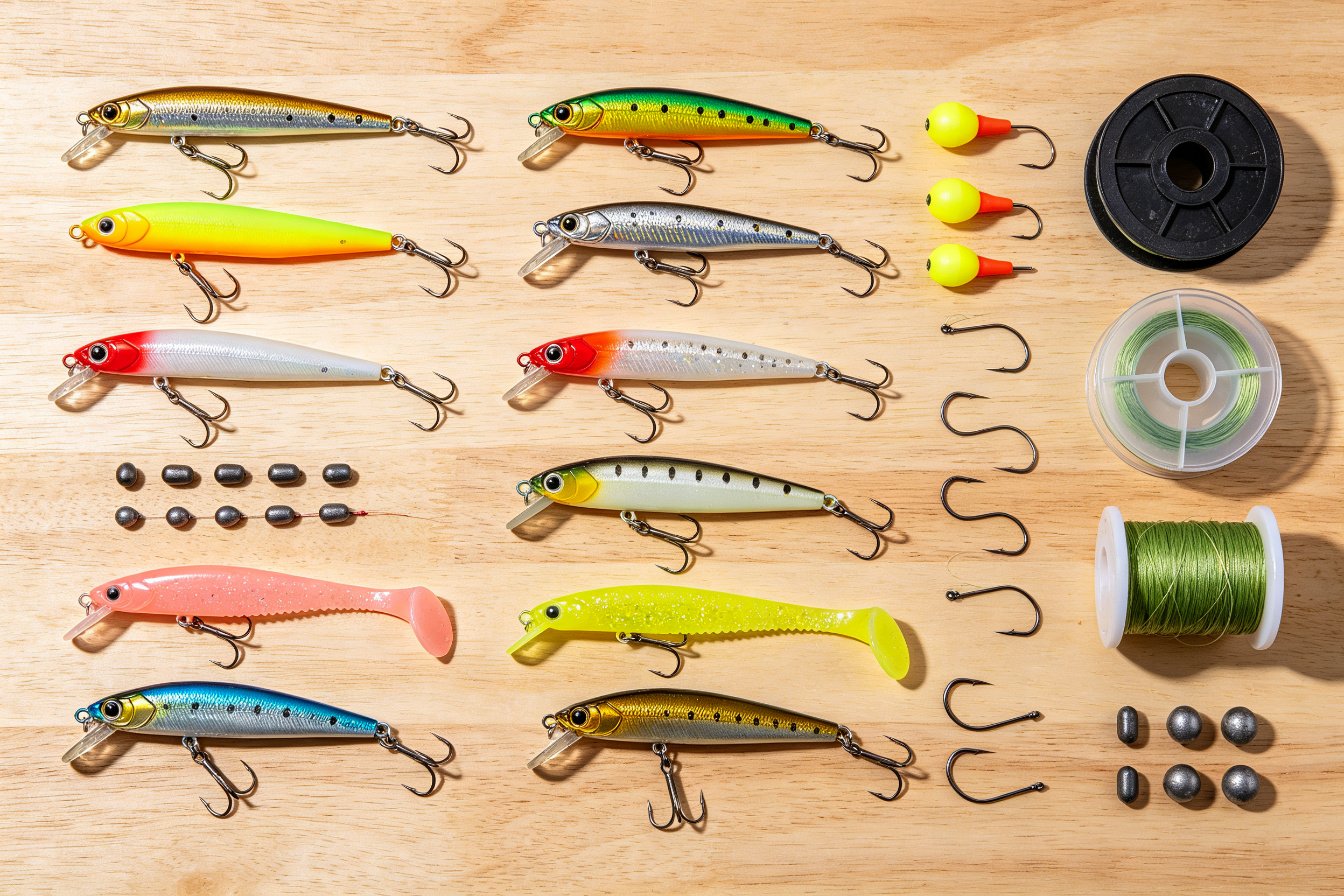
A practical starter mix looks roughly like this: lures and soft baits 30%, line 20%, hooks and terminal tackle 20%, rods and reels 15%, tools and accessories 15%. You can see live examples of a small-batch wholesale assortment in our Bait & Lures category to calibrate your own opening order.
Find a Wholesale Fishing Tackle Supplier You Can Trust
This is the decision that makes or breaks your margin. Most new shop owners buy from whoever is cheapest, then discover too late that quality is inconsistent or the “supplier” is a middleman inflating the price.
A reliable wholesale fishing tackle supplier should be able to answer four questions without hesitation:
- Where are you located, and do you manufacture or trade? Direct factory suppliers (like those in China’s Gaoyang cluster — one of the world’s largest fishing tackle production bases) generally give better pricing and more consistent quality than trading companies.
- What is your MOQ, and does it match my size? If you are a small shop, you want a supplier with low minimum order quantities — not a pallet minimum you cannot move in a year.
- Can I get a sample first? A real supplier sends samples. A fake one talks you into a big order before you have touched the product.
- Can you grow with me? Look for private-label / OEM options so your shop can build its own brand later.
We go deeper into supplier vetting and MOQ negotiation in our Sourcing Guides section — it is the same playbook we use ourselves. For the full end-to-end process, start with our Fishing Tackle Wholesale Guide, which covers sourcing, comparing and importing in detail.
Understand MOQ, Samples & Pricing Before You Order
Two numbers rule every wholesale order: MOQ (minimum order quantity) and unit price. They are linked — lower MOQ usually means a slightly higher unit price. For a small shop, the right trade-off is not the absolute lowest price; it is the price at the MOQ you can actually sell through.
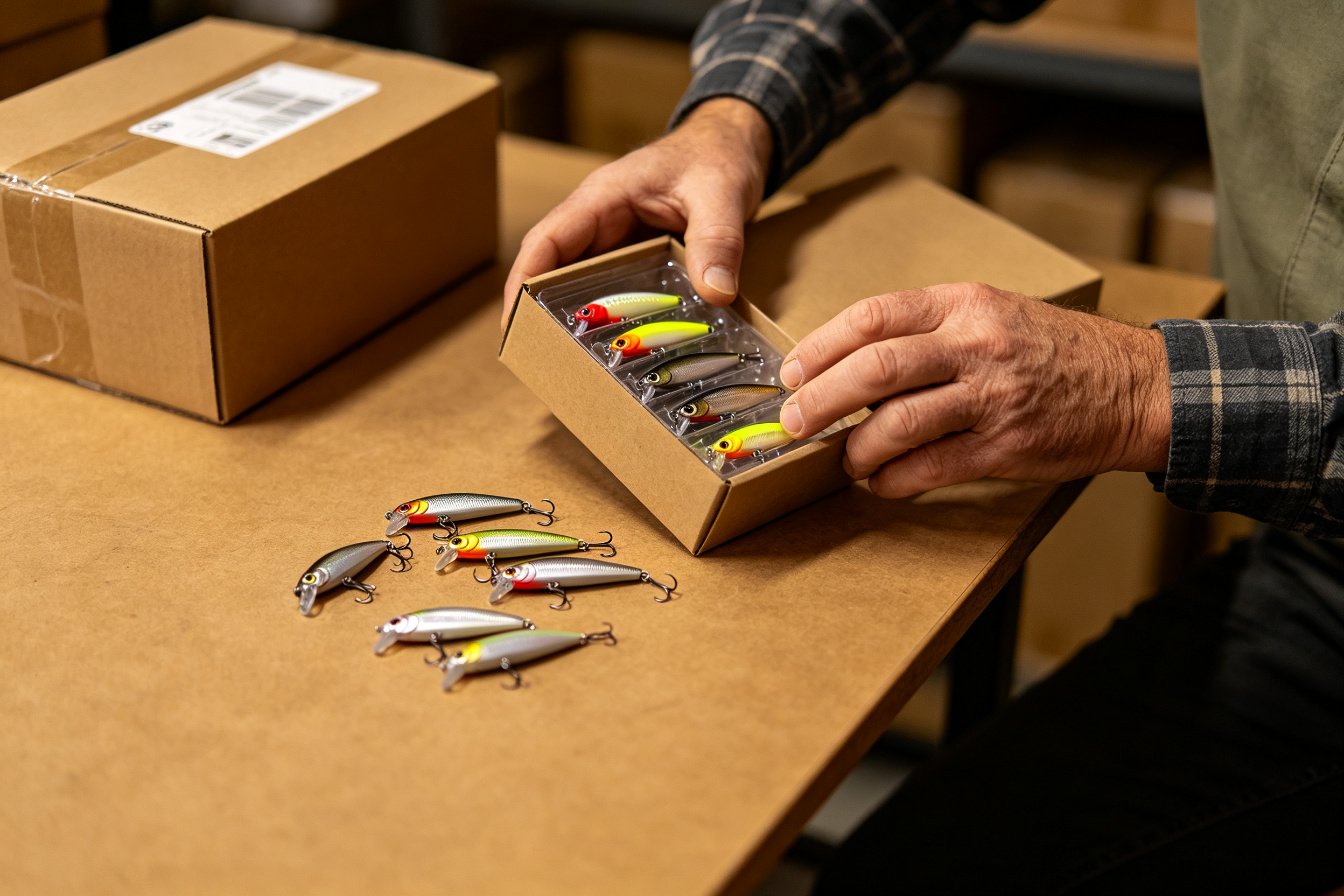
Always order samples before your first bulk order. Sample cost is the cheapest insurance in this business. Check:
- Actual color, size and weight against the listing photos
- Packaging quality — will it survive retail shelf and shipping?
- Finish consistency across a small batch
Once samples pass, negotiate: ask about tiered pricing (better unit price at higher quantities), freight options, and whether they can mix multiple SKUs into one MOQ.
Price for Retail: Build Your Margin
Your margin is your business. A common retail pricing method is keystone markup (double the landed cost), adjusted by category:
- Impulse / terminal tackle (hooks, sinkers, floats): 2.5–3x — customers expect these cheap and buy them often.
- Lures and soft baits: 2–2.5x.
- Rods and reels: 1.7–2x — lower percentage, higher absolute dollars.
Remember to count landed cost, not just the factory price: product cost + freight + duties + payment fees + packaging. A lure that costs $1.00 at factory can be $1.35 landed — price it as if it is.
Set Up Your Shop, Website & Logistics
- Licenses and structure: Register your business, get the right resale/trade licenses, and set up basic accounting — tackle retailers share the same licensing, zoning and insurance basics as any small retailer, a point Guidesly’s tackle retailing guide spells out for shop owners.
- Website (if online or hybrid): Keep it fast, mobile-friendly, and clearly showing wholesale / bulk options — B2B buyers leave sites that hide pricing behind a login with no explanation.
- Shipping: For tackle, lightweight items ship cheaply, which is why online tackle works. Set clear shipping tiers and a low threshold for free shipping to boost average order value.
Launch, Market & Reorder Smart
Launch with the seasonal calendar, not a random date. Stock spring bass gear in February–March, saltwater and summer gear by May, ice fishing by November. Match your promotions to the season your customers are already thinking about.
After launch, watch sell-through (units sold ÷ units stocked). Anything under 40% after 90 days is a signal to discount or stop reordering. Reorder the winners, prune the losers, and let data — not gut feel — drive the next PO.
Fishing Tackle Shop FAQ
How much money do I need to start a fishing tackle shop?
A lean online-only start can work with roughly $3,000–$8,000 for initial stock and setup. A small brick-and-mortar shop typically needs $25,000–$60,000 when you count lease, fixtures, insurance and a wider opening inventory. The exact number depends heavily on location and how deep you stock.
What is a good MOQ for fishing tackle when starting out?
It depends on the item. Hooks and sinkers can have MOQs of a few hundred pieces; lures are often 10–100 per color; rods might be 5–20 per model. For a small shop, look for a supplier who can mix multiple SKUs into one MOQ so your first order is diverse, not deep.
Should I buy samples before my first bulk order?
Yes, always. A sample order is a few dollars and a few days; a wrong bulk order ties up your cash for months. Test color, size, packaging and finish consistency before you commit.
Can I get private-label (custom-brand) fishing tackle as a small shop?
Often, yes. Many factories offer OEM options where you can put your own label on lures, soft baits and packaging. It usually makes sense after you have proven a product sells — not on your very first order.
Do wholesale suppliers accept small first orders?
Many do, and this is exactly what low-MOQ wholesale platforms were built for. Confirm the MOQ, sample policy and whether they can mix SKUs before you commit.
Ready to Stock Your First Order?
You now know the playbook: pick a model, plan a mix, vet your supplier, understand MOQ, price for margin, and reorder by data. The next step is putting it into action with a supplier you can trust.
At FishNaut (Liemar Sports Goods Hebei Co., Ltd) we manufacture and wholesale fishing tackle from China’s Gaoyang production cluster with low MOQs, sample-first ordering, and support for small shops and growing brands alike. Tell us what you want to stock and get a wholesale quote — no strings attached.
Get a wholesale quote → Contact FishNaut | WhatsApp +86 155 1223 4776 | sales@fishnaut.com